What is Hot Air Oven Diagram Parts, Principle and Applications Explained
Wiki Article
Those who have spent significant amount of time working in the laboratory understand that sterilization process not only depends on the temperature itself, but on the consistency of the temperature in the chamber. Every extra degree or two counts at the end of the day, especially when it comes to laboratory instruments. This makes the Hot Air Oven Temperature an extremely important parameter during the drying and sterilization process.
Hot air ovens are used in almost any laboratory for drying the laboratory glassware, sterilization of metal instruments, heating the powdered substance and removing moisture. In contrast to the traditional steam sterilizers, the hot air oven design uses the dry air and becomes extremely effective during the drying process.
Some lab technicians prefer using dry heat sterilizers rather than the traditional glassware, as the former is immediately ready for use.
Temperature and Time Chart
The required temperature usually depends on the material placed inside the chamber. Different items absorb and transfer heat differently, so sterilization timing also changes.
This Hot Air Oven Temperature and Time Chart reflects commonly used dry heat sterilization practices followed in laboratories and research facilities.
What is a hot air oven?
A hot air oven is basically an insulated heating chamber used for sterilization and drying applications. Instead of steam pressure, the system depends on heated air circulation.
Inside the chamber, heat moves continuously around the materials until the required sterilization temperature is maintained for a fixed duration.
You will normally see a Laboratory Hot Air Oven used in:
Pharmaceutical laboratories
Research facilities
Hospitals
Biotechnology centers
Industrial testing environments
One reason these ovens continue to remain popular is that the process itself is uncomplicated. Most operators can understand the workflow quickly without advanced technical training.
Hot Air Oven Working Principle
The working principle of the hot air oven is quite simple. An electric heater slowly increases the heat inside while an exhaust fan blows hot air through the chamber shelves. This airflow makes it easier to minimise temperature differences inside.
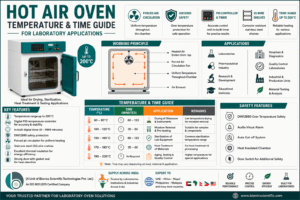
The common process in sterilisation is composed of the following steps:
1. Pre-heating
The chamber will heat up to the necessary temperature prior to charging the material into it.
2. Air heating and circulation
During the heating stage air will be heated and circulated through the entire chamber. Retention Time
3. Retention Time
The furnace will hold the selected temperature for the period specified.
4. Cooling Phase
The chamber cools before materials are removed.
In practical use, proper airflow matters more than many people initially expect. Uneven air movement often creates hot and cold sections inside older ovens.
Hot Air Oven Price in India
The cost of hot air ovens depends on the size of the oven, its temperature range, insulating materials, ventilation process, automation, etc. Hot air ovens that are mounted on a bench are popularly used in laboratories and educational institutions, while industrial ovens are favored in manufacturing industries.
Why Dry Heat Sterilization is Still Used
Despite being faster than steam sterilizers, there are circumstances where dry heat is preferred.
Dry Heat Sterilization Works Well For:
Metal instruments
Glassware
Powders
Oils
Moisture-sensitive materials
Because no steam is involved, the risk of rust or moisture residue becomes much lower.
In busy microbiology laboratories, this becomes useful when large batches of glassware need to be sterilized repeatedly throughout the day.
Common Applications in Different Industries
Hot air ovens are used in more places than most people realize.
1. Laboratory Applications
Glassware sterilization
Chemical drying
Sample preparation
Dry heat sterilization
Microbiology work
2. Industrial Applications
Component drying
Material testing
Stability testing
Heat treatment procedures
The Large Scale Industrial Hot Air Oven may run non-stop in production settings where heating is required as part of the process of manufacturing.
Difference Between the Two Systems
The old-style ovens used heat convection whereas the new-age ovens use heat convection by means of forced air.
1. Natural Convection
Slower airflow
Less temperature uniformity
Suitable for delicate lightweight samples
2. Forced Convection
Faster heat transfer
Better temperature consistency
Improved drying efficiency
More reliable sterilization
Most laboratories today prefer forced-air systems because temperature recovery is usually faster during continuous operation.
Advantages of Hot Air Ovens
There is a reason laboratories continue using hot air ovens year after year.
Common Benefits
Moisture-free sterilization
Lower corrosion risk
Consistent heating performance
Suitable for glassware and metals
Reduced maintenance complexity
Long operational life
Another practical advantage is simplicity. Compared to some advanced sterilization systems, hot air ovens are relatively easier to maintain.
Limitations You Should Know
Like every laboratory system, hot air ovens also have limitations.
Common Drawbacks
Longer sterilization cycles
Unsuitable for plastics or rubber
Higher temperatures required
Slower than autoclaves
Certain microorganisms resist dry heat
For this reason, laboratories often use different sterilization methods depending on the material type.
Hot Air Oven Temperature Range
The normal Hot Air Oven Temperature Range usually falls between:
50°C to 250°C
Up to 300°C in industrial models
The exact range depends on the application, chamber design, and process requirement.
Some of the more sophisticated hot air ovens can even have:
PID Digital Controller
Safety Alarms
Pre-programmed heating patterns